The Bear Got Shallower, Not Dead
Every bill got paid. A friendly country added five billion dollars. Hormuz reopened.


Three weeks ago we listed the bills Pakistan had to pay in April and asked whether the bear market would get shallower or take another leg down.
Every bill got paid. The bear got shallower, but is not dead.
And somewhere in the middle of those two sentences, a friendly country walked into the World Bank-IMF Spring Meetings in Washington and put five billion dollars on the table that nobody expected.
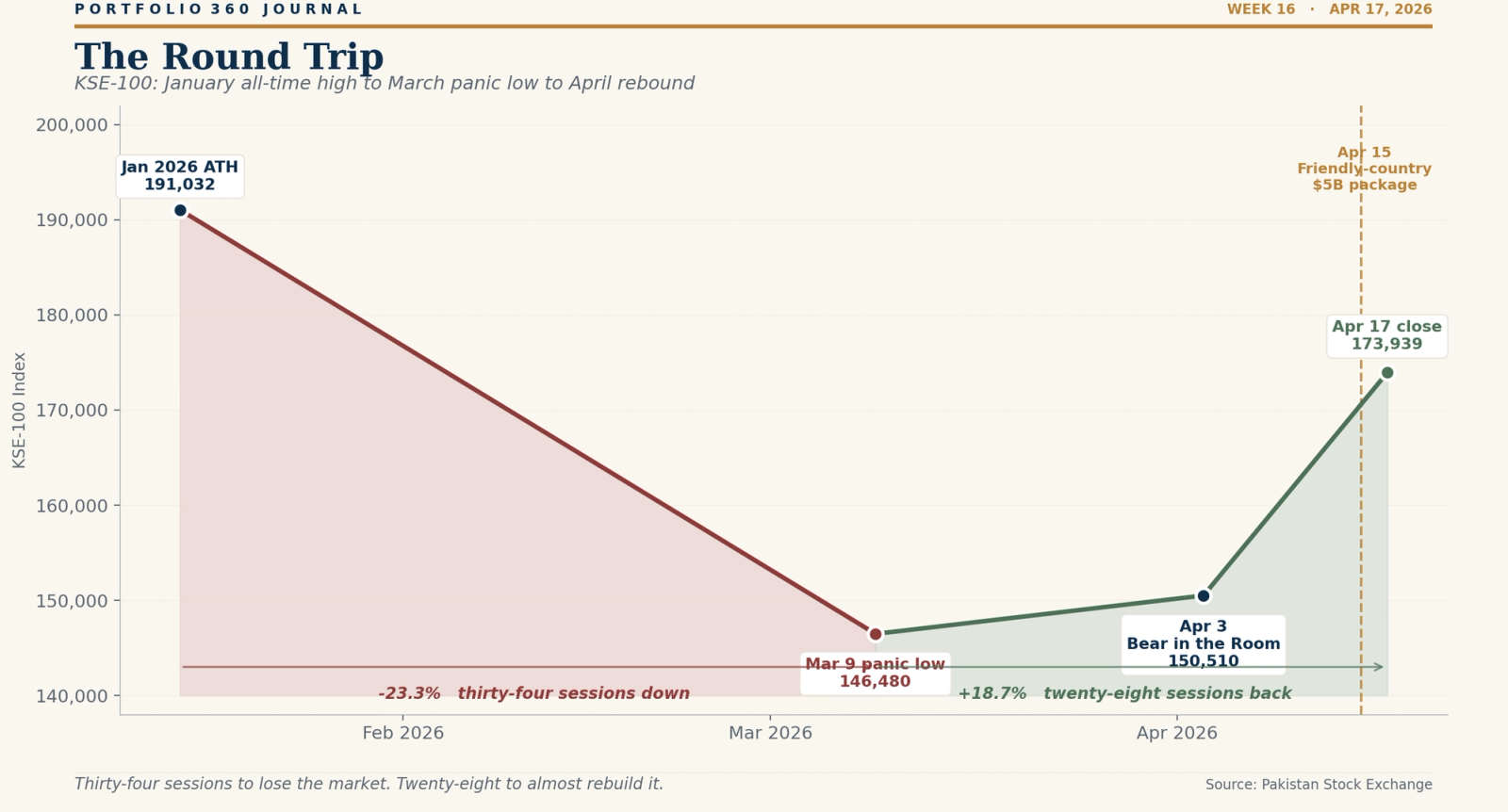
The KSE-100 closed Thursday at 173,939, up 15.6 percent from where we wrote The Bear in the Room on April 3, and within touching distance of the January all-time high of 191,032. Thirty-four trading sessions to lose the market. Twenty-eight to almost rebuild it.
If you held through that round-trip, this week was the vindication. If you watched from the side, the next fortnight matters more than the last one did.
This blog is about what did the work, what could still break, and what you as a retail investor should do before Monday morning.
Every Bill Got Paid
On April 3 we walked through four specific risks stacked inside this month: the Eurobond on April 8, the $3.5 billion friendly-country run-off, the IMF Board approval, and whether any remaining bilateral partner would step in before the calendar tested the reserves.
The Eurobond was paid on schedule. The market took it as a non-event, which was the correct response, but also not what was priced in three weeks earlier.
The $3.5 billion run-off is largely complete. Most of it has cleared through the month, and the remaining piece is scheduled for later this week. This is the first time in seven years that this particular deposit is being repaid rather than rolled over, a signal the government has chosen to absorb rather than contest.
The IMF Staff Level Agreement signed on March 27 still awaits Executive Board approval, which is expected in the coming weeks. Aurangzeb confirmed on April 14 that it remains on track. Board approval of a signed SLA is a formality in almost every case, and there is no indication this is the exception.
And then, the surprise.
The Five Billion Dollars Nobody Expected
On April 15, on the sidelines of the World Bank-IMF Spring Meetings in Washington, Pakistan and a friendly country signed a package that few analysts in either country had priced in. Three parts.
A $2 billion deposit landed in the State Bank of Pakistan that same day. A further $3 billion was committed, with disbursement expected over the coming weeks. And the existing bilateral deposits, previously subject to annual rollover, were moved into a longer-tenure arrangement running to 2028, removing a source of uncertainty that has hung over Pakistan's external accounts for more than a decade.
Relative to reserves of roughly $16.4 billion at end-March, this is not a rounding error. It is a rewrite of the question everyone was asking three weeks ago. The question then was whether Pakistan could survive the April calendar. The question now is what Pakistan does with the breathing room.
Three things change for the equity market. Borrowing costs have room to come down as the sovereign risk premium compresses. The rupee is better-defended now than it looked two weeks ago, closing Thursday at 278.92. And foreign investors who had parked Pakistan in the "too risky" folder now have a fresh reason to reopen the file.
The Hormuz Ping-Pong
A second surprise this week is still unfolding. Before close of the week, Iran's foreign minister declared the Strait of Hormuz completely open to commercial shipping traffic. Brent fell roughly 10.5 percent in a single session to close at $88.96 per barrel, its biggest one-day move in years. Global equities ripped higher, the KSE-100 closed up 2.37 percent on the day, and for a moment the entire oil-importer complex breathed out.
Then on April 18, Iran reversed course. In response to the US refusing to lift its naval blockade of Iranian ports, Tehran withdrew the reopening and "regained control" of the strait. If the blockade holds into next week, Brent goes back above $100 and stays there.
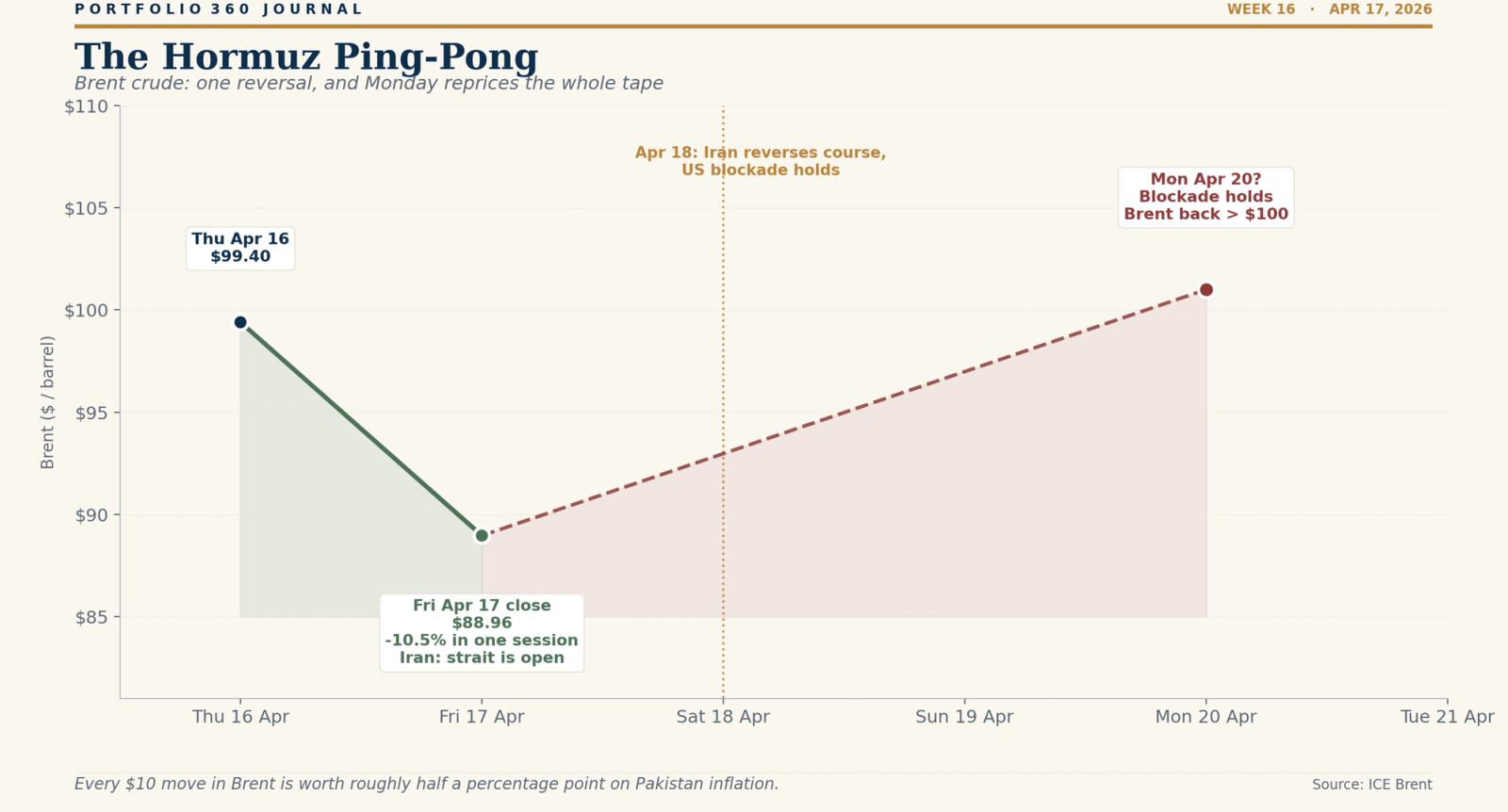
This is the single biggest open question heading into next week. Brent closed Friday pricing in the open case. Monday will reprice the closed case.
For Pakistan, every $10 move in Brent is worth roughly half a percentage point on inflation, and the breathing room that just arrived with the 5BUSD package gets spent faster than anyone wants. Any reader who spent Thursday evening relaxing about oil should treat that relaxation as provisional.
Sector Pulse
Six sector stories this week, and the hierarchy among them is clearer than it has been in months. Banks and exploration look set to lead the tape through May. Fertilizer is the quiet conviction play hiding in plain sight. Auto is the sector nobody is watching yet. Cement and power are context, not centerpieces. Here is how a retail investor should read each one.
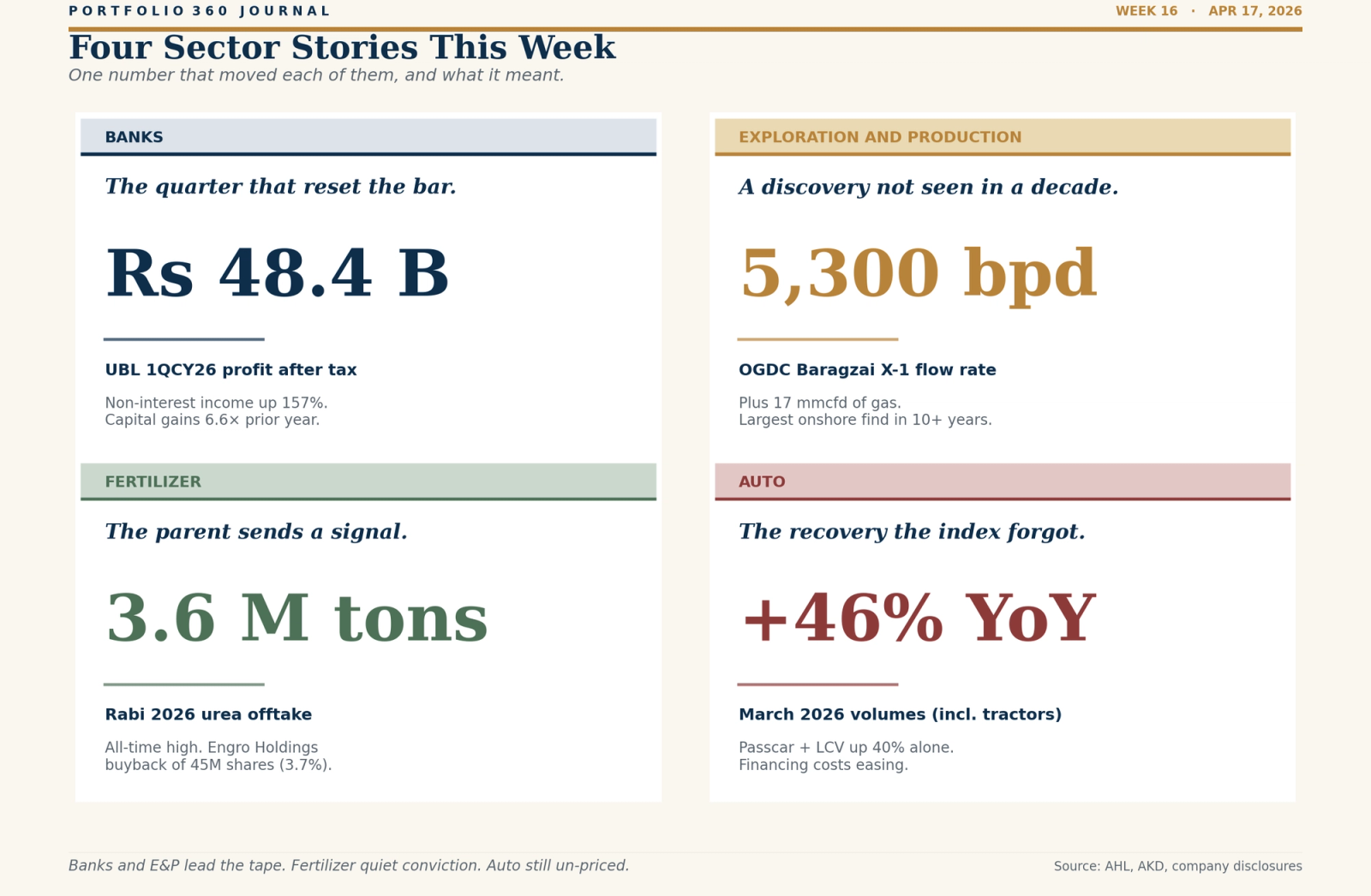
Banks: The quarter that reset the bar.
UBL kicked off earnings season with a quarter big enough to reset expectations for the rest of the sector. Non-interest income and capital gains did most of the work, which tells you where the year is going to be won and lost: banks that held meaningful government paper into the rate cycle are now booking the payoff. HBL, MCB, and BAFL are the next three to report, and the market will read their prints through the UBL lens. Meezan sits in a different lane. Tundra Fonder's March letter named it as a core Pakistan holding for reasons that have nothing to do with the rate cycle, and everything to do with the deposit franchise and the Islamic-banking moat. Worth a re-read.
E&P: A discovery Pakistan has not seen in a decade.
OGDC's Baragzai X-1 this week is, by the company's own disclosure, the largest onshore find in more than a decade: 5,300 barrels per day and 17 million cubic feet of gas, on top of cumulative 3QFY26 additions that take it to 13,470 bpd and 36.5 mmcfd. Pakistan has not been adding material reserves for years, and a discovery of this size quietly changes the story at the margin. The Hormuz question sits on top of this one. If the strait stays contested, every barrel Pakistan does not have to import becomes a little more valuable, and so does every company producing one domestically.
Fertilizer: The parent sends a signal.
Rabi 2026 urea offtake printed an all-time high of 3.6 million tons, which is the kind of number that does not make the front page but tells you something real about rural cash flows. The other development worth flagging is Engro Holdings announcing a buyback of 45 million shares, roughly 3.7 percent of float, between May and October. Buybacks are not always signals, but when a holding company announces one on a visible schedule it is at minimum saying its own board does not think the stock is expensive. Read it for what it is.
Auto: The recovery the index forgot to price.
March volumes were up 46 percent year on year including tractors, and 40 percent for passenger cars and LCVs alone. The headline number is there, the financing cost is coming down, and pent-up demand is finally moving. The index has not priced this yet, which is either a story that keeps building through the second half of the year, or a story that never quite gets there because something else eats the recovery. Worth watching either way.
Cement: A tale of two borders.
The sector split in two this quarter. Domestic-focused names printed very strong despatches; Afghan-export-exposed names printed badly. The dividing line is the border policy, and the border policy can flip. When it flips, the winners and losers swap places. Worth knowing which side each name is on.
Power: The lights stayed on when oil did not.
March generation was up 6.3 percent, hydel did the heavy lifting, and the fuel cost per unit came down. The quieter point is that the grid held together through a week when Brent moved more than $10. That reliability is part of why the rest of the market could focus on the 5BUSD package instead of worrying about the lights.
What to Watch Next Week
Three variables will set the tape next week, and one of them will dominate the other two. Hormuz is the whole game. The IMF Board could approve the program, which is expected and largely priced. The second wave of bank results (HBL, MCB, BAFL) will tell us whether UBL was a sector story or a UBL story. But every one of those will be read through whatever Brent is doing, and Brent depends on what Tehran and Washington decide to do over the weekend.
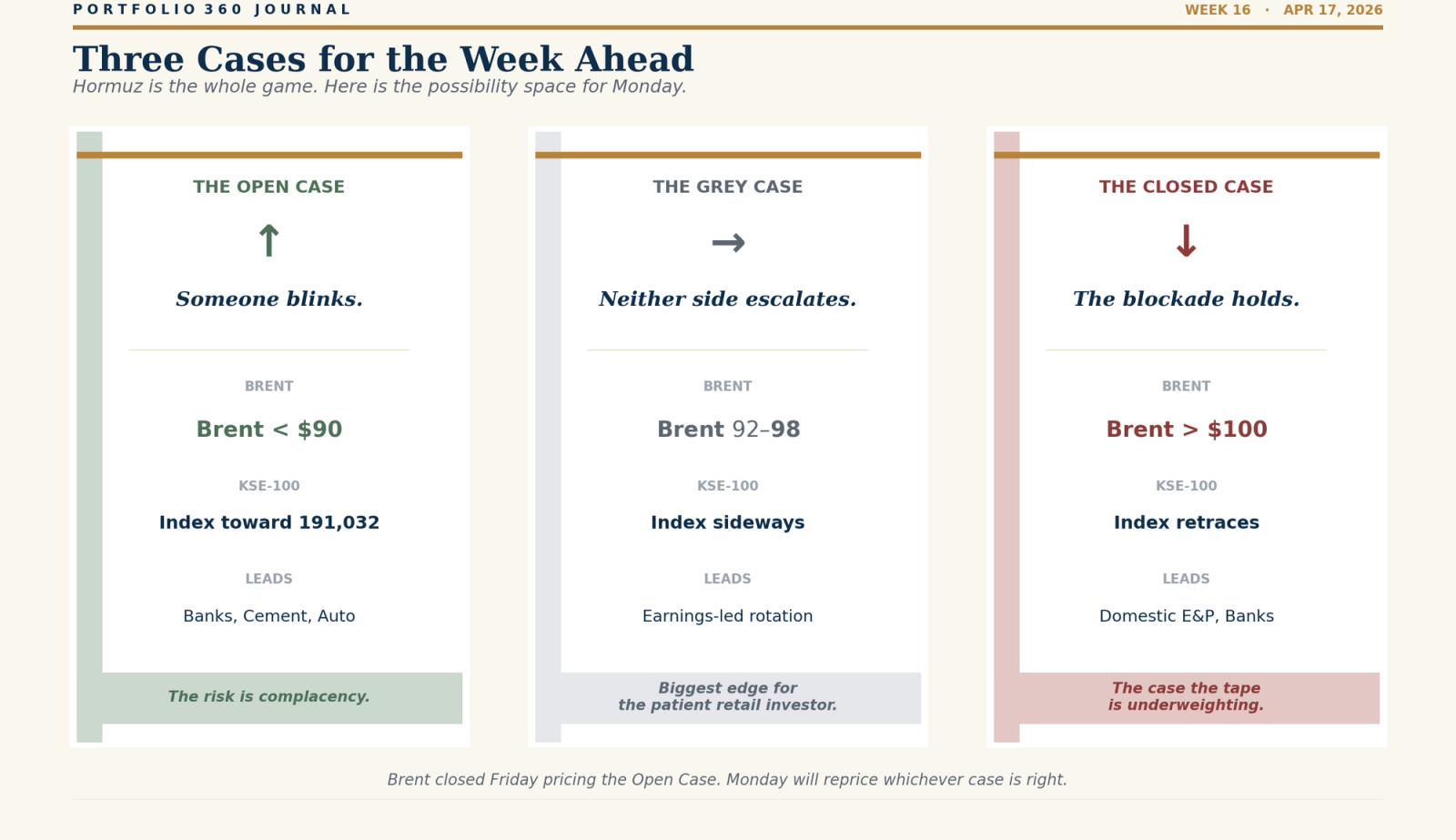
Three cases are worth holding in your head going into Monday.
The Open Case: Someone blinks.
Either Washington eases the blockade or Tehran reopens the strait (or both), the standoff resolves quietly over the weekend, and Brent settles back below $90 by midweek. This is the world the market priced at Friday's close. If it plays out, the KSE-100 pushes toward the January high, banks extend their run on the UBL read-through, and cement and auto get a second leg on softer oil.
The risk in this case is complacency: a market that rips 18 percent in six weeks is a market that stops rewarding caution, which is exactly when caution becomes valuable.
The Closed Case: The blockade holds.
The standoff hardens, tankers keep turning back, and Brent opens Monday above $100 and stays there. Pakistan's freshly-arrived breathing room gets spent on imported fuel faster than anyone planned for. Inflation expectations reset higher, the case for a May rate cut gets harder to argue, and the rotation in the market goes from "everything works" to "only the right things work." Domestic E&P holds up. Banks hold up on the earnings read-through. Everything downstream of fuel prices, cement, auto, textile margins, comes under pressure. This is the case the tape is underweighting.
The Grey Case: Neither side escalates.
The most likely outcome, and the one that gets the least airtime. The strait stays contested but functional, a portion of traffic gets through, Brent settles in a $92 to $98 band, and nobody gets the clean headline they were hoping for. In this world the index drifts sideways for a week, earnings season does the work, and the market starts paying attention to the things it has been ignoring. Auto volumes. The fertilizer buyback. The IMF Board date. The grey case is where a patient retail investor has the biggest edge, because nobody else is watching.
Three other things are worth tracking in the background. IMF Executive Board approval of the Staff Level Agreement could land any day now and should be read as confirmation rather than catalyst. The remaining of 5BUSD package disbursement is expected over the coming days and will show up in the weekly SBP reserves print before it shows up anywhere else. And the second wave of bank earnings will either confirm the sector read-through from UBL or complicate it. All three matter, but none of them will matter as much as what Brent does on Monday morning.
What to Hold in Your Head
Three weeks ago, on April 3, we wrote The Bear in the Room and asked whether this would be a bear that got shallower or a bear that took another leg down. It got shallower. That was not the only possible answer. Today the question has shifted from whether Pakistan could survive April to what it does with the breathing room. The answer has not arrived yet, and anyone who tells you otherwise is guessing. Three things to carry with you into Monday.
First: Surprises cut both ways.
The 5BUSD package was a surprise in the good direction. Hormuz is a surprise still unfolding in either direction. Weeks like this reward patience, not because patience is a virtue but because patience is what keeps you in the room when the next surprise arrives.
Everyone looks smart buying a rally. The work is staying rational when the rally is already underway.
Second: Your biggest edge is not having to do anything.
Institutional money has to be invested. Foreign flows have to be reported. Funds have to justify deviating from benchmark. You do not. If you held the drawdown and your book now looks different than it did three weeks ago because your winners ran, the question for Monday is not whether to sell; it is whether the shape of your portfolio still reflects your own conviction. If you exited or stayed in cash, the question is not how to catch up. It is how to prepare for the next setup, because the next setup will arrive on a timeline that does not care about the last one. Either way, the right response is to make your portfolio easier to sleep with, not to react to the tape. The one advantage you have over the professionals is that nobody is watching you from above.
Third: The signals are quieter than the headlines.
The Engro Holdings buyback. Tundra reiterating Meezan. Urea offtake at an all-time high. The grid holding through a week when Brent moved $10. None of these made the front page. All of them tell you something about where cash is actually flowing in this economy. The headlines will be about Hormuz. The signals will be about cement despatches, bank earnings, and fertilizer sales. Learning to tell the two apart, week after week, is the entire game.
We are walking alongside you, not out in front of you. If anything this week made you nervous, let the nerves sit over the weekend and see whether they still sound sensible on Monday morning. Rallies reward the prepared, not the quick.
Disclaimer: This blog is published by Portfolio360 Journal for educational purposes only. It does not constitute investment advice, a recommendation, or an offer to buy or sell any security. Readers should conduct their own research or consult a licensed financial advisor before making any investment decision.
 MarketsThe Bank Quarter Started To Matter
 MarketsThe Bear Stood Up
 MarketsPakistan's Stock Market Is Not A Stock Market