The Bank Quarter Started To Matter
Brent fell, banks led, the war moved underneath


Last week we wrote The Bear Stood Up and parked one question for this week. Was the nine-session sell-off through April a fresh leg lower, or a correction inside the rally that started in March? We said we did not yet have the right to answer. The market answered for us.
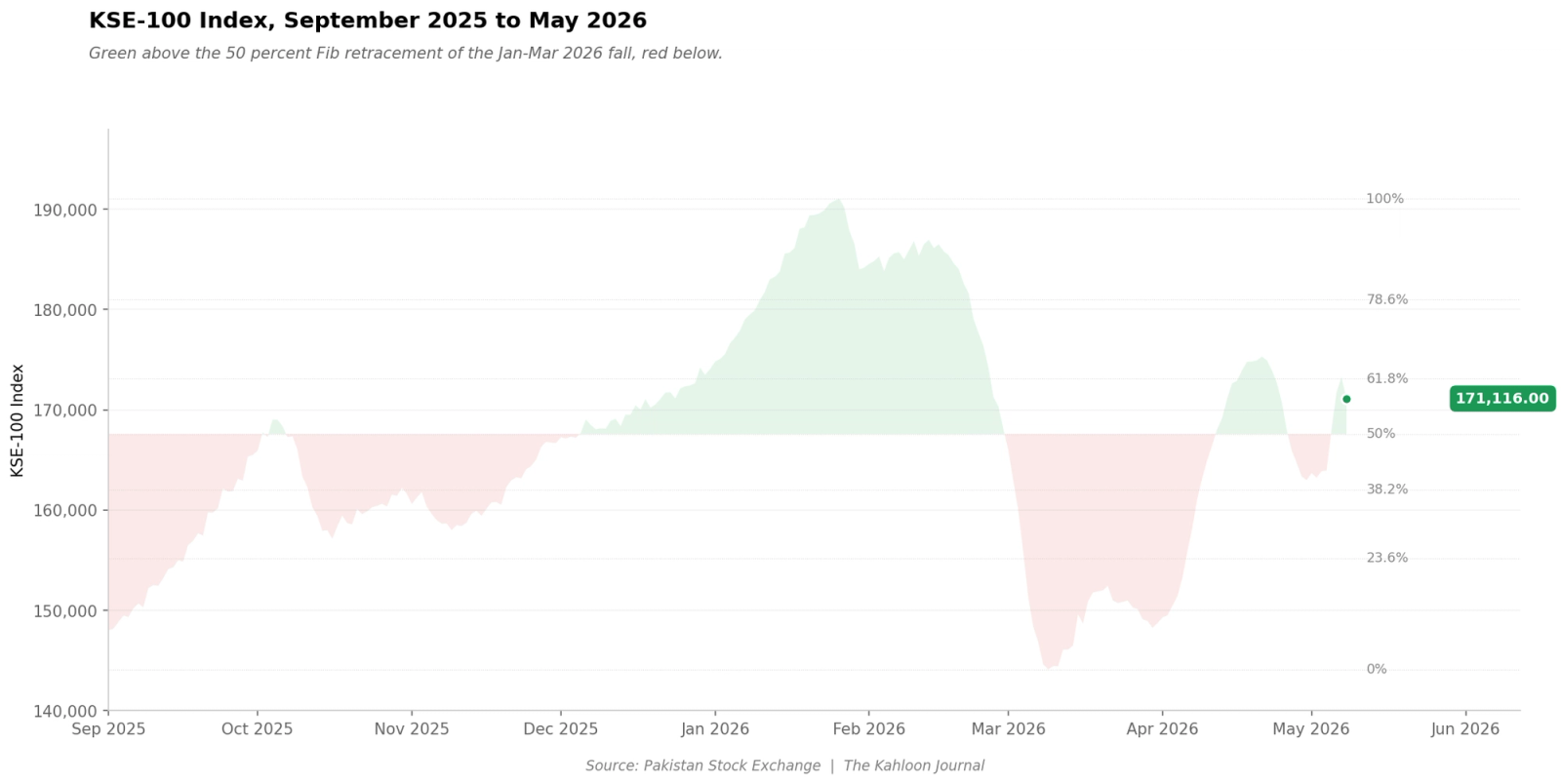
The KSE-100 closed Friday at 171,116, up 8,122 points or 5.0 percent on the week. The pivot was not the IMF. The IMF arrived on schedule on Friday with a $1.2 billion tranche, exactly as the calendar promised. The pivot was Hormuz. Brent fell from $114 to $101 across the week, a 12 percent move, after the U.S. paused its naval operation in the strait at Pakistan's request and Tehran moved closer to a memorandum. The bear that stood up did not collapse. It sat back down.
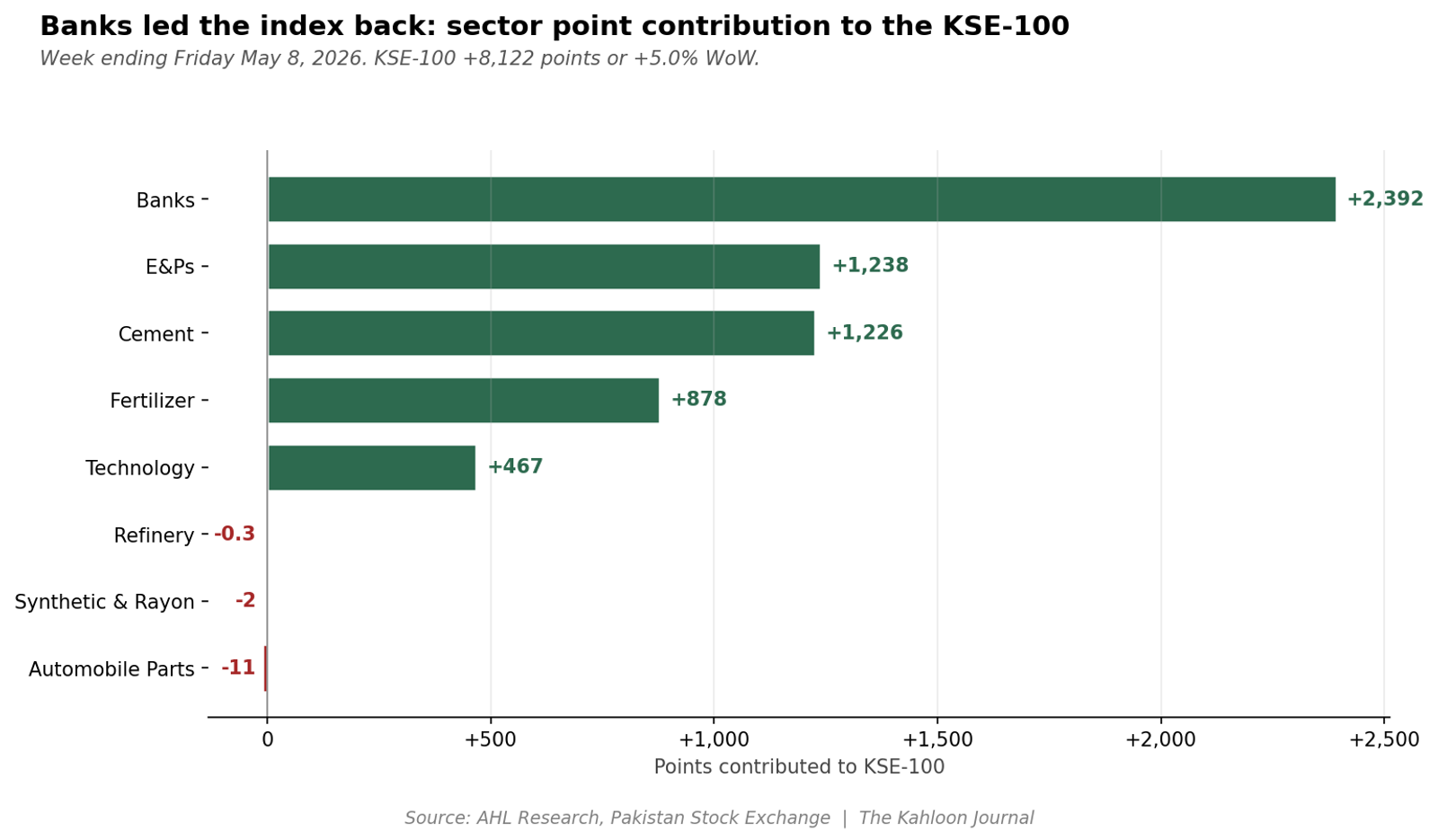
The detail underneath the headline is what makes this week worth reading carefully. Banks contributed 2,392 of those 8,122 points to the index, more than any other sector by a wide margin. UBL alone delivered 1,040 points. The same UBL we wrote about last week, which led the index down with the same money it now leads the index up. The bank quarter we said was your patience reward, not your trading idea, started to vote this week.
The Dashboard Moved
This week the dial at the front of the chain moved, but remains red. The other two reds, CPI and the policy rate, do not print again until the back half of May. They are not the story this week.
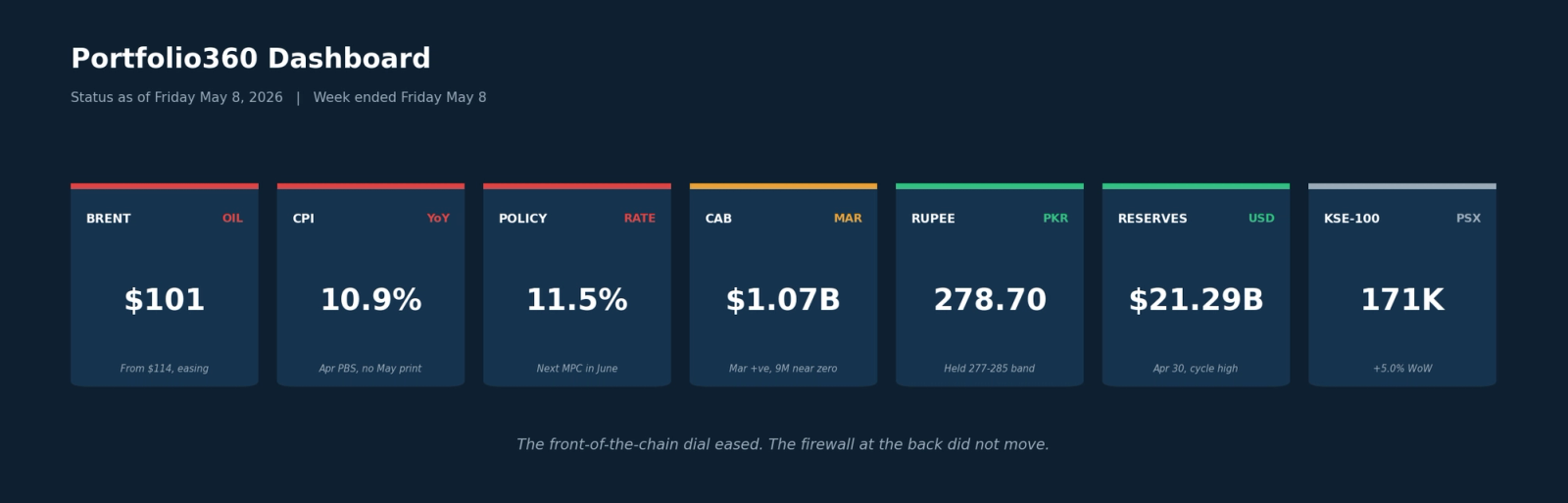
The Brent move came from Hormuz. The U.S. paused its Project Freedom naval operation in the strait. The IMF arrived on schedule. The Executive Board approved Pakistan's $1.2 billion tranche on Friday. Last week we called this approval a confirmation, not a catalyst. The market voted with us. The index closed Friday down 1,778 points despite the approval landing the same day. Approval was already in the price. Friday's intermittent exchange of fire near the strait was the second factor on the day; both pulled the index lower.
Behind both, the firewall did not move at all. Reserves held at the cycle high we marked last week. The rupee closed Friday at 278.70 against 278.77 a week earlier. Through 8,000 points of index volatility and a 12 percent slide in Brent, the rupee moved seven paisas.
Banks, Finally
The week's biggest story is the one we wrote about last week and were told would wait. Banks led the index back. Of the 8,122 points the KSE-100 added on the week, 2,392 came from banks, more than any other sector by a wide margin. UBL alone delivered 1,040 points.
Two of the three large bank quarters reported during the week. MEBL posted 1QCY26 profit of PkR 23.4 billion, an EPS of PkR 13.0. Deposits grew 26 percent year-on-year to PkR 3.6 trillion. Return on equity normalized to 35 percent in the quarter, against a CY23 peak of 56 percent. ABL posted PkR 8.3 billion, an EPS of PkR 7.2, with the lowest non-performing loan ratio in the industry at 1.7 percent. Both banks said the same thing on the policy rate. If Hormuz settles in the next month, the State Bank holds. If the conflict drags, a 50 basis point hike is back on the table. Neither bank is positioning for a cut. HBL is the third large bank still to report; their 1QCY26 is expected in the coming week, with deposit growth and CASA mix the data points to track.
The detail that matters most for next week is the one the headline does not show. Foreigners net sold the banking sector this week. The Foreign Investor Portfolio Investment data show foreign investors offloading 3.21 million dollars of bank stocks during the week, the largest sectoral net sale on the foreign side. The buying that drove the sector higher came from inside Pakistan. Mutual funds and brokers were net buyers of 4.5 million and 6.1 million dollars, respectively. Domestic conviction is back ahead of foreign conviction.
That is the better setup for the next leg of the bank rally, not the worse one. The bank quarter we said would wait for the macro to release it has been released by domestic capital first. What would actually unlock foreign flows back into banks? Two conditions, in our read. Oil holds below 100 for at least two consecutive weeks, removing the inflation transmission risk. And the IMF tranche cycles into reserves, lifting the SBP-held number toward 17 billion dollars by end-June, the level the SBP Governor flagged this week. Either alone is not enough.
Both together would mean the firewall has been validated, not just held. If both clear, the same names that led this week have a second buyer waiting in the wings.
The Micro Is The Macro Now
The dashboard tells you where the cycle is. This week the sector pages told you how far the cycle has traveled.
Hormuz is not only Brent. It is Sulphur in FFC's input cost. The Afghan border is not only a foreign policy line. It is North cement margins and HINOON's Afghan exports. The Qatari RLNG force majeure earlier in the year is not only a winter gas story. It is FFBL's lost urea production and OGDC's curtailed barrels. Three threads, five sector P&Ls, one set of disclosures.
Watch the dashboard for direction. Watch the sector pages for distance. The chain that ran from Hormuz to the index this week ran through five sector pages before it got there.
Sector Pulse
Fertilizer: share war on top, Sulphur underneath
FFC posted 1QCY26 EPS up 32 percent year-on-year, EFERT up 14 percent. FFC's urea market share is now 58 percent against 49 percent a year ago, and DAP share 74.5 percent. The share war we wrote about last week is still going FFC's way.
Sulphur prices have moved from 300 to 1,100 dollars per ton in four months, with 97 percent of global flow transiting Hormuz. Sulphur is the upstream input for DAP, and fertilizer companies have absorbed a meaningful portion of the cost to protect farmer affordability.
Analyst dispersion on FFC is wide. Two leading brokers' Dec 26 fair values diverge by 24 percent. Even the index's largest fertilizer name carries wide forward uncertainty.
Cement: the two-track quarter, confirmed
The two-track quarter we wrote about last week confirmed in the data. FCCL, PIOC, and DGKC posted earnings growth of 62, 56, and 25 percent year-on-year. KOHC and CHCC posted declines of 20 and 16 percent, with gross margin contractions of 4.7 and 9.0 percentage points respectively.
The variable is coal. Cement plants burn coal in their kilns, and the Afghan border closure forced North players onto more expensive imported supply. April dispatches rose 11 percent year-on-year on a 20 percent jump in local sales. North exports went to zero.
Oil chain: three stories, one barrel
Upstream. OGDC crossed 40,000 barrels per day of oil production for the first time in over six years. In an industry where output has been declining for a decade, the milestone says the discoveries program is finally pulling weight. The new Baragzai field is producing 6,000 bpd against potential of 22,000 to 25,000. Another 2,000 barrels a day sit behind pipeline capacity that has not yet caught up. Analyst dispersion on OGDC is the widest in the deck, with two leading brokers' Dec 26 fair values diverging by 50 percent.
Refinery. Refinery upliftment rose 12.7 percent year-on-year in April, led by HSD up 11.3 percent and FO up 26 percent. ATRL took a 13-day shutdown on crude logistics and still grew 32.7 percent year-on-year on volume.
Downstream. OMC sales fell 7 percent year-on-year on demand softness from elevated retail fuel prices. The standout was Furnace Oil, up 63 percent year-on-year to a 27-month high. The country burned more FO in April because RLNG was disrupted. The fuel mix says the macro out loud.
Pharma: where the border shows up
GLAXO posted CY25 PAT up 53 percent year-on-year, with gross margins expanding to 37 percent from 25 percent. The driver: non-essential medicines are no longer price-controlled, so margins repriced fast. HINOON delivered EPS of PkR 77.9, up 21.8 percent, with margins at 54.9 percent. Both earned their addition to the pulse this week.
It is also where the Afghan border is showing up. GLAXO's Balochistan and Khyber Pakhtunkhwa regions, which include Afghan border-related demand, account for 20 percent of revenue. HINOON's Afghanistan exports account for 6 percent. Both flagged regional volume risk in their CY25 disclosures.
What's Lined Up
The calendar runs heavy for the next four weeks. Three prints and one running variable.
April CPI printed at 10.9 percent, the first double-digit reading since July 2024 and driven almost entirely by transport. If Brent sticks below 100 through the rest of May, May's print eases. If not, double-digit becomes the new normal for at least one more month.
The next SBP monetary policy meeting is in June. Both ABL and MEBL guided this week that the next move is either status quo or a 50 basis point hike, depending on whether Hormuz settles. Neither bank guided for a cut. That is a posture shift from where the rate-cycle conversation sat in February and March.
The FY27 federal budget arrives in the first ten days of June. Federal revenue target above PkR 15.5 trillion, primary surplus 2 percent of GDP, and approximately PkR 350 billion of new tax measures. The market wants to know whether the measures hit listed sectors directly and whether tariffs or subsidies favor specific industries.
The variable that overrides everything else is Hormuz. Until the strait fully closes or fully opens, every dial on the dashboard is conditional. Friday's exchange of fire was the reminder that the ceasefire is not a settlement.
On the index itself, the price action is range-bound. The 38.2 percent retracement at 162,040 has acted as recent support, with Apr 30 closing right on it at 162,994. The Golden Pocket, the 61.8 to 65 percent zone between 173,000 and 174,500, has rejected the rally twice from above, on Apr 21 at 175,298 and on May 7 at 173,274. Friday closed at 171,116, between the two.
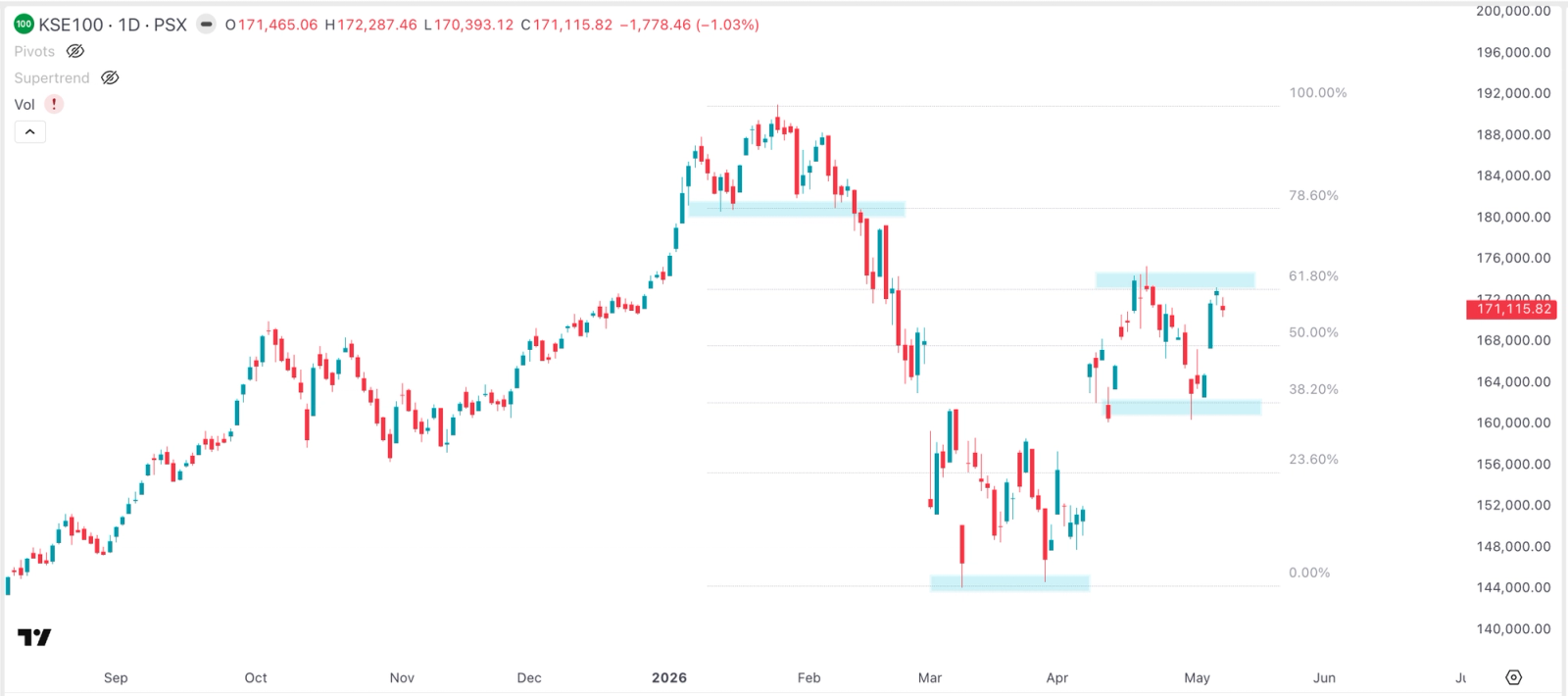
Our read for the week ahead: the range holds. A clean break above 175,000 opens the run to 181,000. A close below 167,500 puts the action back toward the 38.2 percent support. We will reconcile next week.
What to Hold
Three things to hold in your head as you go into next week.
First. The dashboard moved, but the bull case is still conditional. The dial at the front of the chain eased: Brent fell from 114 to 101. The greens at the back held: Rs at 278.70, reserves at $21.29 billion (April 30 print, the cycle high), with the $1.2 billion IMF tranche approved Friday yet to reflect. But CPI and the policy rate did not print this week, and Hormuz could re-escalate by next Friday as it tried to do on Friday this week. The conditions for a sustained bull case are improving, not yet met. Permission, not validation.
Second. The bank quarter we said last week was your patience reward started to matter this week. Domestic capital led, with mutual funds and brokers absorbing every foreign sell. The names that earned their reputations across the rate cycle held them, and the prices are catching up to the earnings. Selling the strong names because of one bad Friday is selling next year's gains for last hour's headlines.
Third. The country is the trade. The lesson from Cycle 4, the rate-cut rally that took the index from 40,000 in late-2023 to 191,000 in January, has not changed. The macro tailwind that powered Pakistan equities for two years is gone, and the structural conditions for a 2008 or 2023-style collapse are not in place. At a forward P/E of about 7.5 times and a dividend yield near 6.4 percent, the index trades at the cheapest and highest-yielding setup among major emerging markets in the region. The bull case got permission this week. Validation would require the firewall to hold through one full month, with Brent still elevated and CPI still in double digits. We are not there yet. Until we are, the trade does not change.
Liked this read? Tap the heart below. If not, drop a comment with what was missing. The next one gets sharper either way.
This blog is published by Khizar Kahloon for The Kahloon Journal for educational purposes only. It does not constitute investment advice, a recommendation, or an offer to buy or sell any security. Readers should conduct their own research or consult a licensed financial advisor before making any investment decision.
 MarketsThe Bear Stood Up
 MarketsPakistan's Stock Market Is Not A Stock Market
 MarketsThe Bear Got Shallower, Not Dead